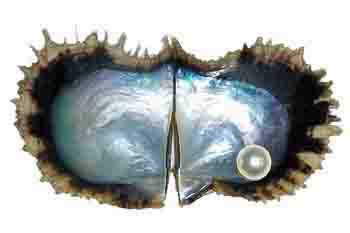
Pearls are truly fascinating gemstones, formed from shellfish. Unlike glittering metallic or mineral gemstones, they are understated gemstones that emit a soft luster, derived from living organisms. Pearls are the birthstone for June. Let’s take a look at the Akoya oyster, a type of pearl oyster.
真珠は貝から出来るとても不思議な宝石です。キラキラ光る金属の宝石や鉱物の宝石とは違い、生物からできる柔らかいの光沢を放つ控えめな宝石と言えます。真珠は6月の誕生石です。真珠貝の中でもアコヤガイとはどんな貝なのかをご紹介します。
Pearl oysters inhabit warm tropical and subtropical seas, attaching themselves to rocks with byssal threads like oysters. They live in depths ranging from about 20 meters to just below low tide. Pearl oysters are bivalves belonging to the family Cordyceps. Adult pearl oysters are about 10 cm in size. Their shape is not like clams or cockles, but closer to that of a scallop. The inside is covered in a beautiful nacreous layer.
アコヤガイは暖かい熱帯、亜熱帯の海に棲息し、カキの様に足糸で岩場にくっついています。深いところでは20mぐらいから干潮時に露出するぐらいの水深に棲んでいます。アコヤガイはウグイスガイ科の二枚貝です。大きさは成貝で10cmほどです。形はアサリ、ハマグリの様な二枚貝ではなく、ホタテガイに近い形状です。内側はきれいな真珠層になっています。
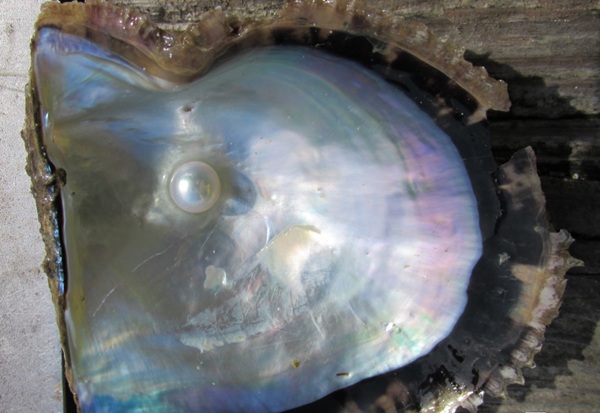
Akoya oysters are mainly cultivated in Ise and Shima in Japan. Cultured pearls are artificially created by inserting a rounded piece of shell called a “nucleus” into the mantle, an organ that secretes components that make up the shell, along with the mantle tissue itself. Natural pearls, on the other hand, are formed when a foreign object accidentally enters the body of a pearl oyster.
アコヤ貝は日本では主に伊勢・志摩で養殖されています。養殖真珠は“核“と呼ばれる貝殻を丸く加工したものを、アコヤガイの外套膜と呼ばれる貝殻作る成分を分泌する臓器の中に外套膜と一緒に挿入して人工的に作ります。一方天然真珠は真珠貝の中に偶然に異物が体内に入り込んで作られたものです。
When a pearl oyster finds a foreign object inside, it attempts to protect itself by encasing the object in nacre, a layer made of the same components as its shell. Therefore, pearls are composed of nacre (calcium carbonate) produced within the oyster’s body. A pearl is formed by the layering of these components multiple times.
真珠貝は中に異物が入ってくると、防衛のためにその異物を貝殻と同じ成分でできた真珠層によって包んで取り込もうとします。ですから真珠は貝の体内で作られる真珠層(炭酸カルシウム)で構成されます。この成分が幾重にも重なることによって形づくられるのが真珠です。
The value of a pearl is determined by its quality. This includes shape (close to perfectly round), luster, nacre thickness, blemishes (presence or absence of blemishes), and size. “Nacre thickness” is a quality unique to pearls, referring to how much of the nacre layer surrounds the nucleus (thickness).
The value of a pearl is determined by its quality: 1. shape (close to perfectly round), 2.Luster 3. Nacre thickness, 4. Presence or absence of blemishes, 5. Size, and 6. Color.
真珠の価値は品質により決まります。1 形(真円に近い)、2 照り(光沢)、3 巻(真珠層の厚み)、4 傷(傷のあるなし)、5 サイズ(大きさ)、6 色 です。
1 Shape
Pearls are not always perfectly round. Various shapes are created due to distortions that occur during the process of nacreous layering. Among these, pearls that are close to perfectly round are considered to be of high quality.

1 形
真珠の形は丸だけではありません。真珠層が積み重なる過程の中で生じる歪みによって、様々な形が生まれます。その中でも、丸(真円)に近いもが良い真珠とされます。
2 Luster
Luster refers to the unique sheen of a pearl and is considered a crucial element, often referred to as “the lifeblood of a pearl.” Luster is created by the combination of the thickness of the nacreous layer and its crystalline structure. The sharper and clearer the shadows and reflections, the better the pearl.

2 照り
In the image above, the pearls on the left have better luster.
照りとは真珠特有の光沢のことで、「真珠の命」ともされる重要な要素です。真珠層の厚さと、真珠層の結晶構造の組み合わせによって照りが生まれます。影や映り込みがシャープではっきりしているほど、良い真珠と言えます。
上の画像では、左側に行くほど照りが良い真珠です。
3 Nacre thickness
“Nacre thickness” is a quality characteristic unique to pearls, representing the amount (thickness) of the nacreous layer surrounding the nucleus. The more layers there are, the thicker and better the pearl is considered, but this is a difficult characteristic to discern. Since a higher nacre thickness results in a larger pearl, it also affects the size of the pearl.

3 巻き
上の画像では、右側に行くほど巻きが厚い上質な真珠です。
巻”は真珠特有の品質で、核の上にどれだけ真珠層が巻いているか(厚み)です。層が何重にも重なっているほど厚みのある良い真珠と評価されますが、見分けが難しい項目でもあります。巻きが多いほど真珠は大きくなるため、真珠のサイズにも関わってきます。
4. Blemishes (Flaws)
In the image above, the pearls on the left have fewer blemishes and are of better quality.
Since pearls are formed naturally, almost all of them have blemishes or stains. Besides blemishes and stains, pearls also have unique indentations called “dimples.” Pearls with fewer blemishes and a smoother surface are considered to be of better quality.

4 キズ(傷)
上の画像では、左側に行くほどキズが少ない良い真珠です。
真珠は自然の中で作られるものであるため、ほぼすべてにキズやシミなどがあります。キズやシミの他にも「えくぼ」と呼ばれる真珠特有のへこみもあります。キズが少なく、表面が綺麗なものほど良い真珠と評価されます。
5 Size
The longer it takes to cultivate pearls to produce larger ones, the higher the risk of blemishes and imperfections. Therefore, generally speaking, larger pearls are valued more highly.

5 サイズ
大きい真珠を作るために時間をかけて育てるほど、キズやシミができるリスクが高まります。そのため、基本的にはサイズが大きい方が評価は高くなります。
6. Color
Did you know that pearls come in different colors? The color of the inside of the Akoya oyster is reflected in the pearl, resulting in a variety of colors. You won’t know what color the pearl will be until you open the oyster. The most valuable colors vary depending on the type of pearl and current trends.

6 色
真珠には色があるのをご存じですか?アコヤ貝の内側の色が真珠に反映されることで、様々な色が表出するのです。どんな色の真珠になっているかは、貝を開けてみるまで分かりません。価値が高い色は、真珠の種類やその時の流行などによって異なります。
Learning the basics of pearls will help you understand why Akoya pearls are loved by so many people.
真珠の基本について知ると、アコヤ真珠が多くの人に愛される確かな理由がわかります。